Starting Today, Tuesday August 31, transfer DDX, YFII and RAD into your Coinbase Pro account ahead of trading. Support for DDX, YFII and RAD will generally be available in Coinbase’s supported jurisdictions with certain exceptions as indicated in each asset page here. Trading will begin on or after 9AM Pacific Time (PT) Wednesday September 1, if liquidity conditions are met.
One of the most common requests we receive from customers is to be able to trade more assets on our platform. Per the terms of our listing process, we anticipate supporting more assets that meet our standards over time. Most recently we have added trading support for COTI (COTI), Axie Infinity (AXS), Request (REQ), TrueFi (TRU), Wrapped Luna (WLUNA), Harvest Finance (FARM) Fetch.ai (FET) Paxos Standard (PAX) and Polymath Network (POLY), Clover Finance (CLV), Mask Network (MASK), Rally (RLY), BarnBridge (BOND), Livepeer (LPT), Quant (QNT), Chiliz (CHZ) Keep Network (KEEP), Polkadot (DOT), Solana (SOL), Gitcoin (GTC), Enzyme Token (MLN), Amp (AMP), and Dogecoin (DOGE).
Starting Today, Tuesday August 31, we will begin accepting inbound transfers of DDX, YFII and RAD to Coinbase Pro. Trading will begin on or after 9AM Pacific Time (PT)Wednesday September 1, if liquidity conditions are met.
Once sufficient supply of DDX, YFII and RAD is established on the platform, trading on our DDX-USD, DDX-EUR, DDX-USDT, YFII-USD, YFII-USDT, RAD-USD, RAD-EUR, RAD-GBP, RAD-BTC and RAD-USDT. order books will launch in three phases, post-only, limit-only and full trading. If at any point one of the new order books does not meet our assessment for a healthy and orderly market, we may keep the book in one state for a longer period of time or suspend trading as per our Trading Rules.
We will publish tweets from our Coinbase Pro Twitter account as each order book moves through the phases.
DerivaDAO (DDX) is an Ethereum token that powers DerivaDEX, a decentralized exchange for derivative contracts. The DDX token allows users to participate in the governance and operation of the exchange.
DFI.money (YFII) is an Ethereum token that governs the DFI.Money platform. The platform is a fork of Yearn.finance and acts as a yield optimizer for tokens deposited to the platform.
Radicle (RAD) is an Ethereum token that powers Radicle, a project that describes itself as an “open-source, community-led, and self-sustaining network for software collaboration.” The RAD token can enable reduced or zero fees when interacting with Radicle smart contracts in addition to governance through voting and proposals.
DDX, YFII and RAD are not yet available on Coinbase.com or via our Consumer mobile apps. We will make a separate announcement if and when this support is added.
You can sign up for a Coinbase Pro account here to start trading. For more information on trading DDX, YFII and RAD on Coinbase Pro, visit our support page.
### Please note: Coinbase Ventures may be an investor in the crypto projects mentioned here, and additionally, Coinbase may hold such tokens on its balance sheet for operational purposes. A list of Coinbase Ventures investments is available at https://ventures.coinbase.com/. Coinbase intends to maintain its investment in these entities for the foreseeable future and maintains internal policies that address the timing of permissible disposition of any related digital assets, if applicable. All assets, regardless of whether Coinbase Ventures holds an investor or Coinbase holds for operational purposes, are subject to the same strict review guidelines and review process. This website contains links to third-party websites or other content for information purposes only (“Third-Party Sites”). The Third-Party Sites are not under the control of Coinbase, Inc., and its affiliates (“Coinbase”), and Coinbase is not responsible for the content of any Third-Party Site, including without limitation any link contained in a Third-Party Site, or any changes or updates to a Third-Party Site. Coinbase is not responsible for webcasting or any other form of transmission received from any Third-Party Site. Coinbase is providing these links to you only as a convenience, and the inclusion of any link does not imply endorsement, approval or recommendation by Coinbase of the site or any association with its operators.
Crypto is a new type of asset. Besides potential day to day or hour to hour volatility, each crypto asset has unique features. Make sure you research and understand individual assets before you transact.
All images provided herein are by Coinbase.
DerivaDAO (DDX), DFI.money (YFII) and Radicle (RAD) are launching on Coinbase Pro was originally published in The Coinbase Blog on Medium, where people are continuing the conversation by highlighting and responding to this story.
Perfect timing and place for a Lightning Network Conference. In less than a week, Bitcoin will be legal tender in El Salvador. The Lightning Network was instrumental for this to happen. The real-life case study for the Lightning Network is El Zonte AKA Bitcoin Beach. And in Mid-November, all of those factors will collide in an event aptly titled “Adopting Bitcoin.”
Related Reading | How Big Is Bitcoin’s Lightning Network? The Answer Will Surprise You
This Lightning Network conference comes with a call-to-action as its unofficial slogan, “Unite, focus, collab!” And, by the looks of Adopting Bitcoin’s official Twitter, the tribe responded to the call and will attend en masse.
Unite, focus, collab! ⚡⚡⚡
“Adopting Bitcoin – A Lightning Summit 2021” #adopt21 brings together the Bitcoin and Lightning communities in El Salvador this November
The focus: transitioning 6+ million people onto the Lightning Network!
What Characteristics Does This Lightning Network Conference Have?
According to “Adopting Bitcoin‘s” website, their purpose:
“… is bringing together the Bitcoin and Lightning community in San Salvador and El Zonte to create connections and foster the future of money and payments in the Central American republic.”
The Lightning Network Conference has the following characteristics:
The team behind the Bitcoin Beach Wallet, Galoy, produced the conference.
“Adopting Bitcoin” is a not-for-profit event.
The organizers will donate 100% to support Lightning Network development.
The Lightning Network conference will be both in English and in Spanish.
“Adopting Bitcoin” will be live-streamed.
They’ll dedicate Tuesday and Wednesday to hard-core conferencing.
Thursday they’ll finish the peregrination by visiting the place that started it all, El Zonte. “We will have an organized Bitcoin Bazaar 10a-4p…. with kiosks, stands and food stalls anchored at / near Hope House,” said Galoy’s Co-Founder.
Tuesday and Wednesday are full conference days in San Salvador.
Thursday is more casual in El Zonte. We will have an organized Bitcoin Bazaar 10a-4p…. with kiosks, stands and food stalls anchored at / near Hope House.
The Lightning Network conference is for “early adopters only.” Tickets can only be purchased with bitcoin over the Lightning Network.
“Adopting Bitcoin” is for “developers, businesses and general enthusiasts to network and form in-person connections.”
Adopting Bitcoin: Lightning Summit in El Salvador. Dates: 16 – 18 November 2021. Tickets can only be paid on the #Bitcoin#LightningNetwork. All proceeds of the conference will be donated to the development of the Lightning Network. https://t.co/vZzQb6MOy9 pic.twitter.com/ivizhyD960
— Bitcoin LightningNetwork+ News ⚡️ (@BTC_LN) August 30, 2021
“Adopting Bitcoin’s” Line Up
Tuesday and Wednesday, the party is in San Salvador’s Sheraton Presidente. Both days contain “Lightning 101” workshops. Among the star lecturers are:
Alex Gladstein, Chief Strategy Officer at the Human Rights Foundation; podcaster extraordinaire Stephan Livera; Bitnob’s Bernard Parah, from Nigeria, one of the protagonists of this historic transaction; “Bitcoin En Español’s” host Camila Campton; Mónica Taher, Tech & Economic International Affairs for El Salvador; Bitcoin Beach’s Mike Peterson, and Paxful’s Ray Youssef.
Full line-up in the Lightning Network Conference ‘s website.
On Thursday 18, the party moves to El Zonte and ends with a literal Taproot Activation Party in El Tunco. For a video tour of both towns, check this mini-documentary out.
BTC price chart for 08/31/2021 on Cexio | Source: BTC/USD on TradingView.com
About Galoy, Organizers Of The Lightning Network Conference
According to their official website, “Galoy offers easy to use Bitcoin ‘Banking-as-a-Service’ (BaaS) products.” They are responsible for the self-referential official wallet for the Bitcoin Beach project. “In October 2020, we launched our branded “Bitcoin Beach” Lightning Wallet in El Zonte.” Galoy describes itself as:
“… a B2B company, serving organizations that embrace Bitcoin as money. We build on the Bitcoin Protocol and the Layer 2 Lightning Network, utilizing the tools created by the team at Lightning Labs.”
Related Reading | Are The Lightning Network’s Almost-Free Transactions The Killer App BTC Needed?
And now, they’re contributing to the Bitcoin ecosystem with this not-for-profit Lightning Network Conference in El Salvador. One that requires that you actually use the novel network to purchase the coveted ticket. And donates all proceeds to Lightning development.
Nice.
Featured Image: Adopting Bitcoin's logo | Charts by TradingView
Customers of leading U.S. crypto exchange Coinbase have spent the weekend panicking after the exchange mistakenly sent emails to users stating their two-factor authentication (2FA) settings had been changed.
On Aug. 27, Coinbase accidentally sent the email to 125,000 of its customers, resulting in widespread public backlash.
Coinbase took to Twitter on Aug. 29 to apologize for the mishap, stating: “We’re laser-focused on building trust and security into the crypto community so that the open financial system we all want is a reality. We recognize that issues like this can hurt that trust.”
I got the reply and panicked someone accessed my account or made withdrawals. Immediately logged in and reset my password after verifying nothing happened.
Despite Coinbase’s apology, many of its users reported taking significant measures in response to the email while fearing that their accounts were being targeted by hackers, including overhauling security settings and liquidating their crypto holdings.
Comments on the exchange’s social media also suggest that numerous customers were unable to access the Coinbase app for several days after the incident.
Same here. the app still says “we’re having connection issues” while other Coinbase users I know, who didn’t get the SMS yesterday, can still log in.
“We will continue to work to gain back the trust of every one of our customers who was impacted by those notifications,” Coinbase added.
The firm also announced it is reimbursing users with $100 worth of Bitcoin (BTC).
The exchange posted its apology in the r/Coinbase subreddit on Aug. 30 to mixed reactions from customers.
Redditor “CoCraic_PNW” claimed they were yet to receive the promised $100 credit despite having received the 2FA message on both Coinbase and Coinbase pro, pledging to move their business to another exchange in light of the incident.
“Film2021” also stated that they were yet to receive the $100 BTC worth of credit and are currently looking to migrate their funds from Coinbase to a rival exchange.
However, not everyone is wielding their pitchforks at Coinbase, with Redditor “Leagance” praising the firm for promptly offering compensation for its error:
“Just got my $100. Thanks Coinbase. Regardless of the situation it was nice to know how quickly and easily I was able to lockdown my account if there was some sort of 2FA change.”
Related: Bitstamp and Ledger execs weigh customer service debate after Coinbase saga
The incident comes just days after it was reported that thousands of disgruntled customers claim their Coinbase accounts were hacked and emptied.
According to a CNBC story published Aug. 24, thousands of users assert that Coinbase’s support has failed to respond to requests for help relating to the alleged incident.
“Interviews with Coinbase customers around the country and a review of thousands of complaints reveal a pattern of account takeovers, where users see money suddenly vanish from their account, followed by poor customer service from Coinbase that made those users feel left hanging and angry,” CNBC wrote.
Earlier this month, Coinbase announced a new support phone line for customers who believe their account has been hacked.
This report updates on what 0xB10C, Coinbase Crypto Community Fund grant recipient, has been working on over the first half of his year-long Bitcoin development grant. This specifically covers his work on Userspace, Statically Defined Tracing support for Bitcoin Core.
By 0xB10C, Coinbase Bitcoin developer grant recipient
The reference implementation to the Bitcoin protocol rules, Bitcoin Core, is the most widely used software to interact with the Bitcoin network. Bitcoin Core is, however, a black box to most users. While information can be queried via the RPC interface or searched in the debug log, there is no defined interface for real-time insights into process internals. Yet, some users could benefit from more observability into their node. Hobbyists and companies running Bitcoin Core in production want to include their nodes in their real-time monitoring. Developers need visibility into test deployments to evaluate, review, debug, and benchmark changes. Researchers want to observe and analyze the behavior of nodes on the peer-to-peer network. Exchanges and other services handling large sums of bitcoin want to detect attacks and other anomalies early.
Peeking inside with Userspace, Statically Defined Tracing
The eBPF technology present in the Linux kernel can be used for observability into userspace applications. The technology allows running a small, sandboxed program in the Linux kernel, which can hook into predefined tracepoints in running processes. Once hooked into a tracepoint, the program is executed each time the tracepoint is reached. Tracepoints can pass data, for example, application state. Tracing scripts can further process the data. The practice of hooking into tracepoints in userspace applications is known as Userspace, Statically Defined Tracing (USDT). For example, these tracepoints are also included in PostgreSQL, MySQL, Python, NodeJS, Ruby, PHP, and libraries like libc, libpthread, and libvirt.
The static tracepoints can be leveraged by Bitcoin Core users wishing for more insights into their node. Adding USDT support did not require intrusive changes, and no custom tooling had to be written. When not used, the performance impact of the tracepoints is minimal to non-existent. Only privileged processes can hook into the tracepoints, no information leaks to other processes on the host. These properties make Userspace, Statically Defined Tracing a good fit for Bitcoin Core.
For example, I placed two tracepoints in the peer-to-peer message handling code of Bitcoin Core. For each inbound and outbound P2P message, the tracepoints pass information about the peer, the connection, and the message. This data can be filtered and processed by tracing scripts. As a demo, I have built a P2P Monitor that shows the communication between two peers in real-time. Users can find this script alongside other USDT examples in the contrib/tracing/ directory of the Bitcoin Core repository.
body[data-twttr-rendered=”true”] {background-color: transparent;}.twitter-tweet {margin: auto !important;}
Use-cases for Userspace, Statically Defined Tracing
I list some use-cases for Userspace, Statically Defined Tracing I have thought about or worked on. With only three tracepoints merged, there is plenty of room for developers to add new tracepoints and get creative with tracing scripts. Issue #20981 contains discussion and ideas for additional tracepoints that can be implemented.
Researchers and developers can use the P2P message tracepoints to monitor P2P network anomalies in real-time. One example could be detecting the recent addr message flooding as reported in this bitcointalk.org post. The messages were announcing random IP addresses not belonging to nodes on the Bitcoin network. The flooding has been covered in detail by Grundmann and Baumstark. They discuss that the attacker could obtain the number of connected peers and learn about other addresses, including Tor addresses, the node is listening on. This would reduce the privacy of the node operator. It’s important to stay vigilant to these attacks, discuss them, and then, if needed, react to them.
Similarly, I have been instrumenting the Bitcoin Core network address manager with tracepoints. The addrman keeps track of gossiped network addresses for potential outbound peers connections a node makes. It’s designed to be resiliant against Eclipse Attacks, where a node only has connections to peers controlled by the attacker. The attacker can choose which information to feed to the node, enabling, for example, double-spending attacks. Information about the addresses in the addrman might help detect the build-up of an eclipse attack when combined with other data.
Additionally, these addrman tracepoints can be helpful during debugging and code review. To showcase this, I build a tool that visualizes the addresses in the addrman data structure based on the data submitted to the tracepoints.
body[data-twttr-rendered=”true”] {background-color: transparent;}.twitter-tweet {margin: auto !important;}
A Prometheus metric exporter can also build on top of the tracepoints without requiring additional code in Bitcoin Core. There already exist RPC-based Prometheus exporters and projects like Statoshi. However, RPC-based exporters are limited by the information exposed via the RPC interface, and Statoshi is large a patch-set that requires maintenance on each Bitcoin Core release. I have published an experimental USDT-based exporter called bitcoind-observer that hooks into the three currently merged tracepoints and serves metrics in the Prometheus format. The exporter can be used by everyone currently running a Bitcoin Core node compiled with USDT support. A demo is available on bitcoind.observer.
The already existing tracepoint validation:block_connected can be used to benchmarking block validation. This allows, for example, to compare the initial block download performance between different patches and can aid in detecting performance improvements and regressions. For example, the bitcoinperf project might benefit from such tracepoints. I’ve used the tracepoint to benchmark Martin Ankerls pull request #22702. If merged, the changes he proposes would result in a substantial block validation speed up and reduction in memory usage.
Next steps
I will collect further ideas for tracepoints and implement them alongside example tracing scripts and more tooling. This will also involve communicating with other Bitcoin and Bitcoin Core developers about which tracepoints could be helpful in their projects. An example is Antoine Riard’s cross-layer anomaly detection watchdog which he initially proposed as a new, internal module to Bitcoin Core. However, many of the required events and metrics can be collected by hooking into tracepoints. This means the watchdog could be an external runtime, which would speed up the watchdog development and requires less code and maintenance on the Bitcoin Core side.
If everything goes according to plan, the v23.0 release of Bitcoin Core, expected in early 2022, will include the first set of tracepoints. A goal is to enable USDT support in release builds by default, which still needs some work. Additionally, the tracepoint API should be semi-stable and thus needs testing.
In short: I have been adding tracepoints to Bitcoin Core that users can hook into to get insights into the internal state. The tracepoints are based on Linux kernel technology and do not require intrusive changes or custom tooling. The groundwork is done. Now further tracepoints can be added, and tooling can be written.
Coinbase is officially seeking applications for our 2021 developer grants focused on blockchain developers who contribute directly to a blockchain codebase, or researchers producing white papers. Learn more about the call for applications here.
Userspace, statically defined tracing support for Bitcoin Core was originally published in The Coinbase Blog on Medium, where people are continuing the conversation by highlighting and responding to this story.
Geneva, Switzerland, August 30, 2021 — Liti Capital’s wLITI token, a wrapped version of the Swiss company’s LITI equity token, lists today on Changelly PRO, 30 August 3 PM UTC. $wLITI pairs with BTC and USDT are now available for trading.
This comes less than a week after listing on Bitcoin.com Exchange and less than two weeks on HitBTC. The Changelly PRO team has expressed their warm welcome to the litigation financing token.
“We are happy to welcome $wLITI to our big family of carefully curated cryptocurrencies and hope that our users will gain maximum benefits from this collaboration. We are proud to partner with a company that provides financial resources, strategic solutions and renowned connections to the best law firms worldwide to help plaintiffs obtain court awards for damages or losses they have suffered,” says the Changelly PRO spokesperson.
Liti Capital, a Swiss-based blockchain private equity fund specializing in raising capital for legal cases, is making waves in traditional investing by bringing litigation financing to the masses, an investment practice traditionally monopolized by hedge fund heavyweights and elite investors.
Litigation financing is the practice of bringing in investors to cover the cost of a lawsuit or arbitration in exchange for a portion of the profit. Litigation financing specialists, such as Liti Capital, purchase litigation assets for cases they deem to have a high chance of winning.
“We appreciate the amazing support that established exchanges such as Changelly PRO have shown for our $wLITI token. With high profile projects in the blockchain and decentralized finance spaces finally attracting mainstream interest, we are excited to explore the possibilities for $wLITI as a wrapped version of an equity token that offers regular people the chance to invest in an asset class that previously wasn’t available to them,” says Liti Capital CEO Jonas Rey.
wLITI is an ERC-20 wrapped version of the LITI equity token. Launched on June 29, 2021, the wLITI token is suitable for trading on centralized exchanges (CEXes) like Changelly PRO, and also on DEXes, whereas the LITI token is only available through liticapital.com after meeting KYC requirements.
Liti Capital uses the blockchain to manage its share registry. Development of its own blockchain-based case management tools is on its roadmap.
wLITI can be exchanged for LITI at a token buyer’s request via Liti Capital’s app or website, which converts LITI to wLITI at a 1:5000 ratio and vice versa. The tokens will always maintain this ratio. The buyer is then able to trade their wLITI freely. Liti Capital does not directly sell wLITI.
LITI is a true digital share of Liti Capital that has voting rights, pays dividends and is protected under Swiss law. LITI is purposely not designed to be on exchanges at this time.
Both tokens represent Liti Capital, whose mantra is “Private Equity for All.” Liti Capital works exclusively in a single form of private equity — Litigation Finance, also called third party funding. This asset class has remained almost entirely exclusive to hedge funds and venture capitalists since its inception several decades ago. Litigation Finance is the practice of financing all or part of a legal case on behalf of a plaintiff for an agreed upon percentage of the court award.
Once Liti Capital purchases a portion of ownership of a case, it provides capital that can be used in many ways: legal fees, case management and strategy, expert witnesses, intelligence work and whatever else is needed to give the plaintiff the best chance of winning the case and collecting the award. The portion owned by Liti Capital becomes a “litigation asset” that backs the LITI token.
On 19 August 2021, Liti Capital announced that it was funding a claim against Binance, which would enable affected individuals to pursue compensation in relation to the exchange failing on 19 May 2021. This failure resulted in the trading accounts (including Futures, Margin, and Leveraged Token products) of at least 700 and potentially thousands of individuals being effectively untradeable for hours, causing traders to suffer losses that could exceed one hundred million dollars.
Listing Details
Trading Opening: Aug. 30, 2021 3 PM UTC
Trading Pairs: wLITI/BTC | wLITI/USDT
About Liti Capital
Switzerland-based Liti Capital is a Swiss limited liability company specializing in litigation finance and fintech. Liti Capital buys litigation assets to fund lawsuits and provides a complete strategic solution along with connections to top law firms to help clients win their cases. Tokenized shares of the company lower the barrier of entry for retail investors and give token holders a vote in the company’s decision-making process. Dividends are distributed to LITI token holders upon the success of the plaintiff. Jonas Rey, co-founder of Liti Capital, also heads Athena Intelligence, one of the most successful intelligence agencies in Switzerland. His two co-founders, Andy Christen and Jaime Delgado, bring operational, innovation and technical skills to round out the leadership team.
Liti Capital recently onboarded seasoned industry leader David Kay as chief information officer and executive chairman. Boasting more than a decade of experience as funding partner and portfolio manager of a billion-dollar private equity fund in the litigation financing space, Kay successfully enforced what was at the time the largest international arbitration award in history, bringing in over $1 billion in cash and securities.
For project information, please read the Whitepaper.
For token distribution, please read Tokenomics.
Liti Capital Official Channels
Liti Capital Website: https://liticapital.com
Liti Capital Telegram: https://t.me/Liti_Capital_Official
Liti Capital Telegram Announcements: https://t.me/Liti_Capital_Official_ANN
Liti Capital LinkedIn: https://www.linkedin.com/company/liti-capital
Liti Capital Medium: https://medium.com/@liticapital
Liti Capital Reddit: https://www.reddit.com/r/liticapital
About Changelly
Changelly provides an ecosystem of products and services that enables customers to have a one-stop-shop experience when engaging with crypto.
Operating since 2015, Changelly acts as an intermediary between crypto exchanges and users, offering access to 200+ cryptocurrencies that can be effortlessly swapped within 10 minutes on desktop and on the go via the Changelly mobile app.
In 2020, Changelly branched out to accommodate the needs of traders. Changelly PRO has been built as a platform focused on the customer’s needs, effectively enabling retail buying and selling of digital tokens and coins. Piggy-backing on the great support system found within Changelly, Changelly PRO will provide the community with high limits, effective pricing, fast execution and 24/7 live support.
Melbourne, Australia, Aug. 30, 2021 — The world’s first halal DeFi ecosystem MRHB DeFi is collaborating with leading Indian cryptocurrency trading platform Coinsbit to bring crypto-asset opportunities to India’s huge population of 200 million Muslims, driving further participation in the blockchain economy.
MRHB DeFi’s vision of an inclusive crypto-verse, follows Islamic ethical finance principles but is suitable for those looking for a socially conscious blockchain that avoids interest, usury, exploitation and other business practices deemed unethical.
Being Halal means that MRHB DeFi operates within the highly ethical constraints of Shariah law which broadly implies that all business decisions are conducted in conjunction with Islamic teachings which promote inclusion, access, and faith, and function simply and transparently for the benefit of its users.
A Visionary Partnership to Serve 200 Million Muslims
India is home to 200 million Muslims constituting 10% of the global population and is the world’s third-largest Muslim community. This group is often excluded from the cryptoverse due to their faith-driven principles regarding financial and business conduct.
What this partnership means:
Coinsbit would be the first Indian exchange to introduce a certified Shariah-compliant project to the Muslim Community. MRHB will conduct an initial exchange offering (IEO) on the Coinsbit Exchange during launch and introduce the blockchain’s native token, $MHB (Marhaba Token), to the global community
Coinsbit is headquartered in Hyderabad which is geographically close to the large metropolitan community of Hyderabad & Bangalore that has a sizable of Muslim population
MRHB DeFi will integrate Coinsbit’s portal with its app (Sahal Wallet), enabling users to directly use Coinsbit for trading crypto-assets.
Coinsbit will give the users a trading platform, where $MHB (Marhaba Token) would be available to the Indian Community
MRHB DeFi would also lead marketing activities for the exchange in the fast-growing Australian market
Both the partners will gain substantially from each other’s marketing and community growth activities
A Shared Mission for an Inclusive Cryptoverse
“Blockchain and DeFi have exploded in popularity in 2021, and we forecast this stratospheric growth to continue. That’s why we’re excited to be teaming up with one of India’s premier cryptocurrency exchanges to offer MRHB DeFi products and services to everyone across the Indian subcontinent who are looking for a true, ethical alternative to the existing platforms in the cryptoverse,” says Naquib Mohammed, MRHB DeFi Founder & CEO.
“Blockchain offers amazing potential for all communities. We aim to deliver this potential to those who may have previously struggled to access or been cautious to use DeFi products and services. We also hope to provide them with all of the rich opportunities for growth, expansion and development that DeFi offers,” adds Naquib.
“We’re excited about embarking on this shared journey with MRHB. Islamic DeFi and Shariah-based crypto financial products are an area of extraordinary growth and potential for India. We’re committed to delivering MRHB DeFi’s visionary range of services and products to our clients across our continent,” says Ravneet Kaur, CEO of Coinsbit India.
She continues, “The time is right for a blockchain project that is based on the tenets of faith, inclusion and access for all, while being transparent and simple to use. MRHB DeFi has demonstrated to us that they are committed to a long-term vision for ethical people around the world no matter what their faith is.”
Asian countries are outpacing the rest of the world in terms of cryptocurrency adoption and India has ranked second in the global cryptocurrency adoption index, according to the 2021 Global Crypto Adoption Index by blockchain data platform Chainalysis. Indians have invested more than five times the amount of the previous year and the momentum is encouraging.
Crypto adoption is on the rise in India and the Indian exchanges WazirX, CoinDCX and Coinswitch Kuber have doubled their user base between January and March 2021.
Coinsbit India started its operations recently and has already captured market attention by onboarding a million users in around three months.
About MRHB DeFi
MRHB DeFi is a halal, decentralised finance platform built to embody the true spirit of an “Ethical and Inclusive DeFi” by following faith-based financial and business principles, where all excluded communities can benefit from the full empowerment potential of DeFi.
Based on the tenets of blockchain such as trust, transparency, and security, MRHB DeFi has encapsulated universally applicable principles of Shariah into those tenets of blockchain to render a suite of offerings. It is a complete DeFi ecosystem whose products, protocols and crypto-assets are governed primarily by the ethical, inclusive, sustainable and charitable investment principles associated with the Islamic faith or ‘Islamic Finance’ (‘IF’ as it is commonly known).
The diverse team is comprised of researchers, technocrats, influencers, Islamic fintech experts & business entrepreneurs, who came together to ensure that MRHB DeFi prevails in a manner that will impact society as a whole, essentially bridging the gap between the faith-conscious communities and the blockchain world.
Read more about MRHB DeFi’s Shariah Concept Paper, Lite and White Paper here.
Since its inception in 2017, Coinsbit has been one of the most trusted exchange platforms for cryptocurrency traders from around the world. Coinsbit India aims to become the leading trading platform for the Indian market, which is just beginning to realize the potential of cryptocurrencies. It always works according to the guidelines set by the government of India. Coinsbit India is committed to providing a service, reliability and convenience that cannot be matched by any other platform, and as one of the world’s largest cryptocurrency exchanges, is proud to represent India.
Dogecoin: one of crypto’s most hyped coins. It seems as if it is always in the mouths and minds of young investors. Moreover, more notable investors have praised the coin both for its comedic origins and as a viable “medium of exchange.”
But what exactly is this comical fad? Additionally, what does it have to do with a Shiba Inu? Why is it that both Mark Cuban and Elon Musk are promoting this coin despite the fact that it literally started as a joke? The answers may surprise you.
The Origins Of Dogecoin
If you have heard the rumors, it is true: Dogecoin, quite literally, is a joke coin. Billy Marcus, a co-creator of Dogecoin, initially minted the coin in 2013. Bragging to CNBC, he says the coin was created in, “about two hours.”
The original Doge meme in its glory | Source: Wikipedia
Originally made as a parody of Bitcoin, and based off of the popular “doge meme,” Dogecoin spread like wildfire in the world of crypto. From Investopedia, “Jackson Palmer, a product manager at the Sydney, Australia office of Adobe Inc., created Dogecoin in 2013 as a way to satirize the hype surrounding cryptocurrencies. Palmer has been described as a “skeptic-analytic” observer of the emerging technology, and his initial tweets about his new cryptocurrency venture were done tongue-in-cheek.”
Related Reading | Latest News On Dogecoin, Trends And Analysis
Later on, Marcus reached out to Palmer to create a new cryptocurrency. When Marcus’ desire to create a crypto and Palmer’s scrutiny towards crypto met, Dogecoin was born.
From Investopedia, “Markus based Dogecoin’s code on Luckycoin, which is itself derived from Litecoin, and initially used a randomized reward for block mining, although that was changed to a static reward in March 2014. Dogecoin uses Litecoin’s scrypt technology and is a proof-of-work coin.”
Who Is Behind The Hype?
As you have probably heard by now, Elon Musk, now crowned “Daddy Doge” by many crypto enthusiasts, has been a huge supporter of the coin. In an SNL skit called “Weekend Update,” Musk is seen participating in a comical bit featuring the coin. As the skit ends, Musk is seen yelling, “To the Moon!’ The studio audience is heard cheering following Musk’s remark. As a result, Dogecoin saw a spike in their prices shortly after Musk’s appearance on SNL.
Related Reading | Every Doge Has Its Day: Dogecoin Founder Buys Back Into DOGE
Mark Cuban, a multi billionaire investor, is also a huge supporter of the coin. As of recently, Cuban pitched in on his thoughts for Dogecoin, “It’s a medium that can be used for the acquisition of goods and services. The community for doge is the strongest when it comes to using it as a medium of exchange.” Despite this remark, Cuban has faced scrutiny over the fact that he owns less than $500 in the coin.
What Is Next?
Just recently, notable figures have joined the Dogecoin Foundation. Vitalik Buterin, Ethereum’s founder, has just joined the team. Additionally, Jared Birchall, head of Musk’s family office, has joined the team as well.
Will this joke coin reemerge to comical heights? Recent drop amist crypto gains suggests otherwise | Source: DOGEUSD on TradingView.com
Despite a recent drop in prices, the team remains optimistic. According to Yahoo, “Now, the group is looking for three years’ worth of funding to hire a staff and work on Dogecoin full-time.” As always, the future is uncertain, but recent changes to the group can most definitely be viewed as a positive for Dogecoin investors.
Featured image from iStockPhoto, Charts from TradingView.com
“One of the greatest tragedies in life,” according to author K. L. Toth, “is to lose your own sense of self and accept the version of you that is expected by everyone else.” For the people of Afghanistan — almost 40 million of them — the loss of self, as well as the loss of life, has become a brutal reality. With the Taliban in control, chaos now reigns supreme. As businesses shut down, tens of thousands of people are desperately trying to flee the country. Moreover, as the political system collapses, so too does the financial one.
As CNBC’s MacKenzie Sigalos recently noted, Afghanistan is “a country running on legacy financial rails.” This painful reckoning, 20 years in the making, has resulted in a “nationwide cash shortage,” as well as “closed borders, a plunging currency, and rapidly rising prices of basic goods.” The people are desperate as the country quickly descends into the deepest depths of despair.
According to Sigalos, many of the country’s banks, obviously affected by the country’s swift demise, have been “forced to shutter their doors after running out of cash.” To make matters even worse, Western Union has suspended its services. As Sigalos writes, “even the centuries-old ‘hawala’ system — which facilitates cross-border transactions,” has been closed. The desperation is palpable. The people of Afghanistan require assistance.
Thankfully, grassroots nonprofits are doing their best to offer assistance. They are currently assisting some 20,000 Afghan citizens “still in the country waiting for United State authorities to process special immigrant visas.” This is where the importance of cryptocurrencies comes into play. To raise enough funds to relocate Afghan families, nonprofits are currently accepting Bitcoin (BTC), Ether (ETH), Bitcoin Cash (BCH), Litecoin (LTC), Zcash (ZEC), Gemini dollar (GUSD), Balancer’s BAL, Yearn.finance’s YFI, Polygon’s MATIC, Synthetix Network Token (SNX) and Bancor Network Token (BNT).
For the critics of crypto, many of whom have questioned if it serves any purpose, the events in Afghanistan demonstrate how it can quite literally save lives. This might sound hyperbolic — but it’s not. Besides nonprofits, more and more Afghan citizens are turning to crypto. In the CNBC article, Sigalos spoke with a young Afghan who believes that “a Venezuela-type situation” is on the horizon. It may very well be. According to a Bloomberg report, as the Taliban seized control of Kabul in mid-August, the Afghan afghani — the country’s currency — dropped to an all-time low.
Venezuela may provide a telling blueprint for Afghanistan’s future. The South American country — ravaged by hyperinflation, political instability and United States sanctions — is in a dire state. With the country in the grip of an economic crisis, cryptocurrencies like Bitcoin and Ether have shown their worth. According to Venezuela-based cryptocurrency consultant and Cointelegraph en Español contributor Jhonnatan Morales: “Many people are mining and trading Bitcoin not to acquire products, but to protect themselves from hyperinflation.”
Related: Exploring Venezuela’s crypto ecosystem since the start of the pandemic
Speaking of Venezuela, the nation’s government recently announced plans to remove six zeros from the bolivar. One needn’t be an economist to recognize that the Venezuelan government is doing everything in its power to save a currency that has been in a hyperinflation coma for years. Could the same fate await Afghanistan? If a government isn’t formed soon, don’t bet against it.
In Afghanistan, as the Taliban scramble to impose some political order, cryptocurrencies are also offering Afghans hope. In fact, across this region — in places like Lebanon and Palestine — cryptocurrencies are very much in demand. An increasing number of people from Lebanon and Palestine, all too familiar with depreciating currencies and political instability, are finding solace in crypto. According to Arabian Business, as the Lebanese pound “continues its downward plummet and the economic situation worsens,” people are turning to crypto, both as an investment and as a means of transferring their funds abroad. Furthermore, according to the report, a “growing number of local small businesses, ranging from grocery stores to fashion boutiques,” are accepting payment in Bitcoin.
Related: Why Pakistan and the Middle East can bet on crypto mining
Again, for those who are quick to question why cryptocurrencies are necessary, Lebanon provides more than a few answers. Since 2019, the Lebanese pound has lost around 90% of its value. The political analyst and journalist Marwan Bishara, who has written extensively on the demise of Lebanon, told readers that the Lebanese people have become accustomed to the “shawarma paradox”: Two years ago, “the national sandwich” cost 5,000 Lebanese pounds, or about $2; today, it is priced at 20,000 pounds, less than $1. This may seem darkly humorous, but there is little humor in the demise of the nation’s currency, which is essentially worthless.
Some 120 miles away in Palestine, the independent state’s monetary authority is currently debating whether or not to issue a digital currency of its own. As Palestine seeks to gain further independence from Israeli rule, a digital currency would at least offer it a form of monetary independence. With so many uninformed commentators fixated on the bad actors who use crypto, too few focus on the desperate people who use it to survive. This brings us back to Afghanistan, a volatile place plagued by acts of terrorism and political instability. The future of the country is uncertain, but cryptocurrencies are offering a lifeline to the millions of Afghans whose lives are very much on the line.
The views, thoughts and opinions expressed here are the author’s alone and do not necessarily reflect or represent the views and opinions of Cointelegraph.
John Mac Ghlionn is a researcher and cultural commentator. His work has been published by the likes of the New York Post, The Spectator, The Sydney Morning Herald and National Review.
Data from Cointelegraph Markets Pro and TradingView showed BTC/USD cooling at higher levels after cracking the $49,000 mark late Friday.
The end of the working week had seen a positive reaction to comments from Fed Chair Jerome Powell on tapering of asset purchases, as well as remarks on inflation.
As Cointelegraph reported, stocks surged to all-time highs, while the U.S. dollar weakened — Bitcoin made use of the opportunity and added $1,500 in under an hour.
With talk of a new “bullish impulse” move afoot on crypto markets, the mood into the weekend was thus far from bearish.
“If BTC is able to stay above the ~$49000 level for the rest of the week… It would set itself up for a phenomenal Weekly Close,” trader and analyst Rekt Capital summarized.
That weekly close had a solid chance of beating the last at the time of writing, with $49,300 the level to clinch for a multi-month high.
That would also place Bitcoin back in the tiny two-month window in which it closed above $49,000 on the weekly chart earlier this year.
“Should be pretty obvious where Bitcoin is heading,” popular Twitter account Ryan Cantering Clark added.
A look at buy and sell levels on major exchange Binance on the day meanwhile revealed a support line slowly building at around $48,800, forming a close stand-off with sellers just below $50,000.
BTC/USD buy and sell levels (Binance) as of Aug. 28. Source: Material Indicators/ Twitter
Cardano bulls back in action as altcoins wake up
Altcoins meanwhile mostly benefited from renewed strength in Bitcoin.
With the exception of a flat Binance Coin (BNB), the top ten cryptocurrencies by market cap saw solid 24-hour gains.
Cardano (ADA) bulls led the advance, ADA/USD climbing almost 10% to $2.85 and making up for much of its recently lost ground after hitting all-time highs. Solana (SOL) continued upwards after its own record high.
Protect your account from one of the most commonly used cyber attacks
By Coinbase Security team
The Coinbase Security team observes cybercriminals employing a wide range of tactics and techniques to target the accounts of crypto holders. One of the most commonly used tactics is SMS phishing.
If you believe you’ve received an SMS phishing attack, take these first three steps:
Do not click the link!
Copy the message and send it to 7726 (SPAM), a short-code service established by US-based cell phone carriers to help them detect and block malicious messages on their network
Take a screenshot of the message and send it to security@coinbase.com
What is SMS phishing?
Phishing is a type of online attack in which a cybercriminal impersonates a legitimate entity or authority and attempts to deceive their target into clicking on a malicious link or attachment. This can enable hackers to steal their victim’s sensitive information or infect their device with malicious software.
You may already privy to email-based phishing attacks, in which the attacker delivers a phishing message via email. However, in recent years, attackers have adopted a new type of delivery method — SMS, otherwise known as text messages.
SMS phishing, also known as “smishing”, is a type of phishing attack in which an attacker will spam malicious messages and links to hundreds or even thousands of cell phone numbers to deceive the recipients into taking some action that is against their best interest.
For crypto holders, the intent is to gain access to the recipient’s crypto wallet or account so that they can steal their funds. SMS phishing is largely problematic in crypto for two reasons:
Cybercriminals have an ever-growing incentive to steal crypto assets due to their unprecedented growth in monetary value, and
Crypto asset transactions are irreversible once the transaction has been confirmed and written onto the blockchain ledger.
If you’re invested in crypto, or even considering it, we strongly encourage you to take the time to understand how to identify this common threat and what to do if you receive one of these messages.
How to identify SMS phishing
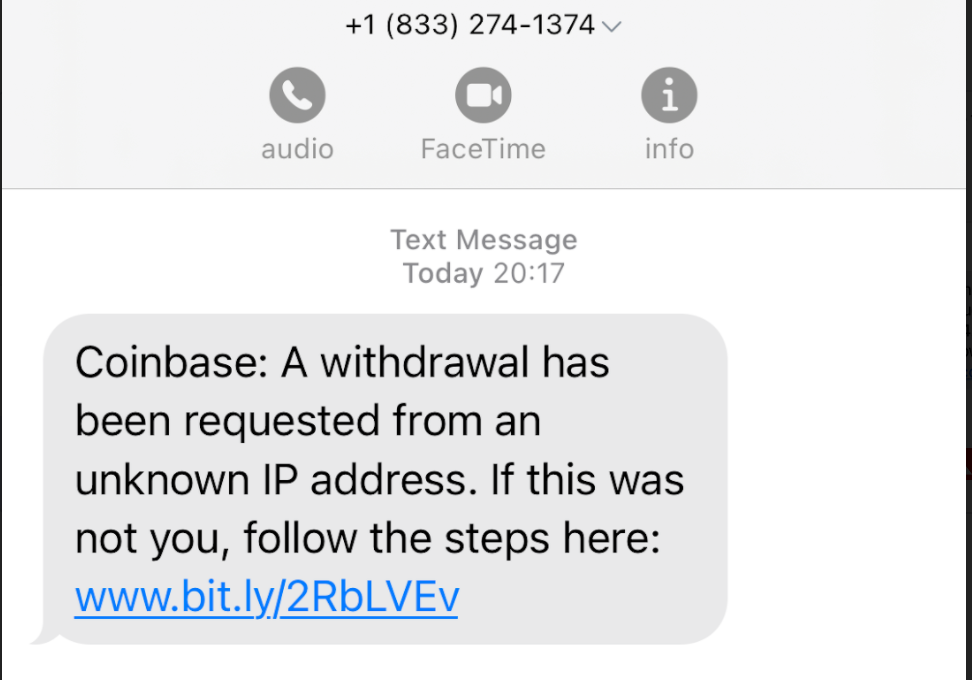
Phishing messages can be easily detected 99.9% of the time by completing three simple checks. Let’s use the Coinbase SMS phishing message below as an example for this lesson:
The Sending Number. One of the first things to check is the phone number from where the message was sent. By doing a quick Google search, you will find that this phone number is likely associated with a scam — your first red flag.
The Message. Grammar mistakes are often a red flag indicating the message is likely a scam. If there are no grammar issues, check the intent of the message. Phishing messages will often attempt to tap into your emotions by either creating fear or excitement. If you receive a message that is emotionally triggering, either good or bad, it may be a phishing message and should be a red flag.
The Link. Lastly, always be sure to examine the link. Plain and simple, if the link does not contain the domain Coinbase.com, it is phishing.
What to do if you receive an SMS phishing message
Now that you’ve got the tools to detect SMS phishing messages, the question remains — what should you do if you receive an SMS phishing message?
Luckily, the right response to protect yourself is easy: Do not click the link!
You can also copy the message and send it to 7726 (SPAM). 7726 is a short-code service established by US-based cell phone carriers like AT&T, Verizon, Sprint, or T-Mobile. By sending a copy of the SMS phish to 7726, you can help mobile carriers detect and block malicious messages on their network.
Lastly, take a screenshot of the message and send it to security@coinbase.com. You’ll be enabling our Security team to investigate the phishing link and submit abuse reports to organizations that can help have the phishing site taken down.
As cryptocurrency grows in popularity, cybercriminals will continue to innovate and attempt to discover new ways to gain access to your investments. Coinbase Security continues to keep our customers abreast of new threats as they arise. However, it is also imperative that you take the security of your account into your own hands. If you’d like to learn more about account security best practices, review our guide on how to keep your crypto secure.
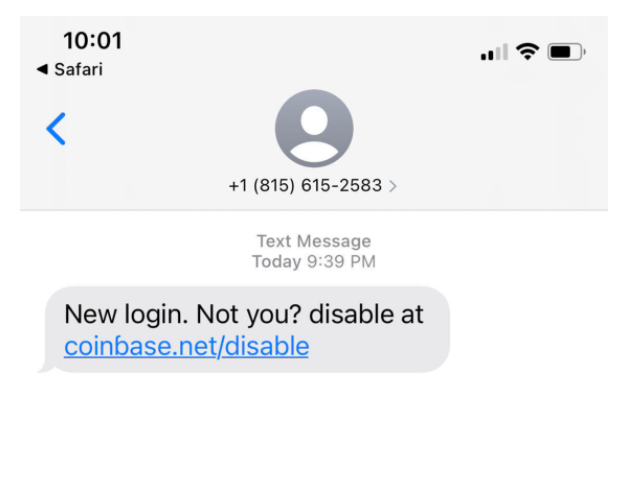
Additional examples of SMS phishing
The phone number is largely unknown according to Google
The message has a grammar issue and is trying to invoke a fear response of unauthorized account access
The link is not Coinbase.com. The domain in this link is what’s known as an Internationalized Domain Name (IDN). Take note of the special character accent on the “b”. Attackers will often use IDNs in phishing attacks since the letters can so closely resemble the word Coinbase.
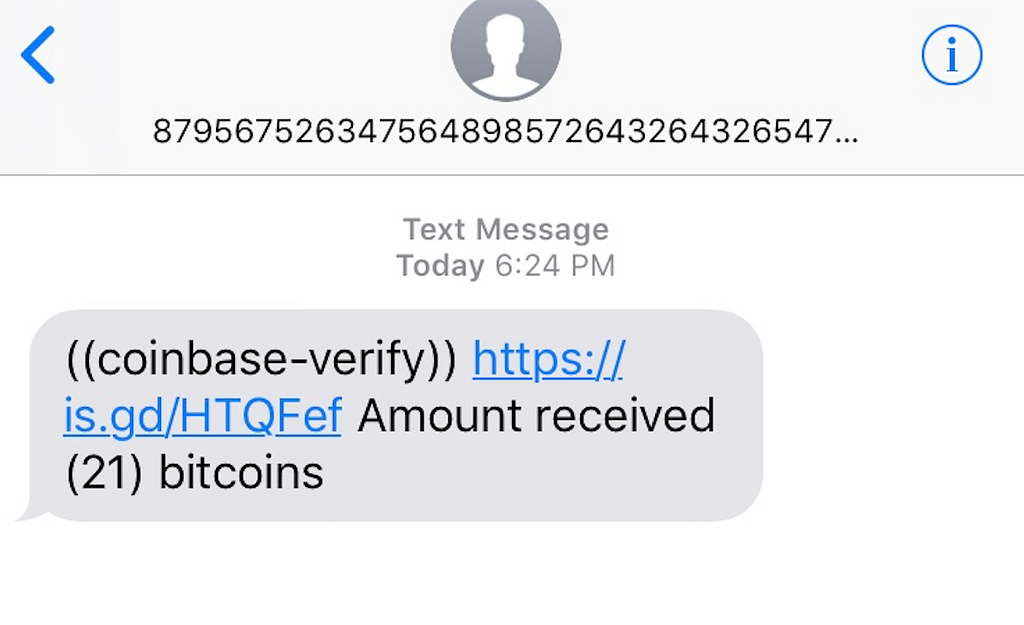
The phone number is abnormally long and suspicious
The message has many grammar issues and is trying to invoke excitement by indicating receipt of 21 BTC
The link is not Coinbase.com
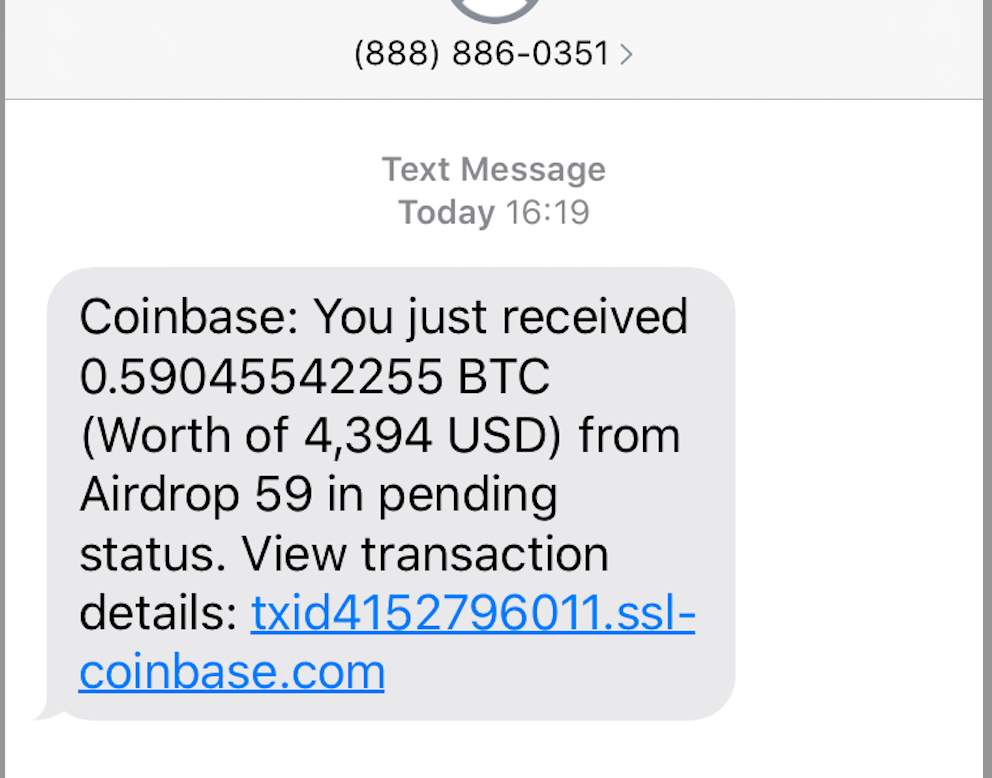
The phone number is largely unknown according to Google
The message is trying to invoke excitement by indicating receipt of 0.59 BTC
The link is not Coinbase.com (notice the link actually goes to the domain ssl-coinbase[.]com)
What you need to know about SMS phishing attacks was originally published in The Coinbase Blog on Medium, where people are continuing the conversation by highlighting and responding to this story.










 Will this joke coin reemerge to comical heights? Recent drop amist crypto gains suggests otherwise | Source: DOGEUSD on TradingView.com